
The technologies and practices shaping software development this year.
2024 brought no dazzling revolution to software engineering. What is happening is quieter and runs deeper: development teams are restructuring how they work, so that a small group can maintain more systems without trading away quality.
Put differently, the focus has moved from "write code faster" to "keep the system easy to change for years".
What development teams are prioritising

All figures in this article are simulated and used to illustrate the trend — they are not the result of an official survey.
1. AI-assisted coding
AI is now a default tool in the editor, but its role has shifted: from "write this snippet for me" to helping read legacy systems, generating tests, reviewing pull requests and drafting documentation. That is where the real time is saved, because most of a developer's effort goes into understanding, not typing.
It comes with a new discipline: every AI suggestion goes through review exactly like human code, with no exception for anything touching security or money.
2. Cloud-native architecture and containers
Containers are no longer only for large companies. The practical value is not "it runs in the cloud" but that development, staging and production environments are identical — which removes the entire "works on my machine" class of bugs.
The counter-trend is just as visible: many teams are returning to a well-modularised monolith rather than splitting into microservices on day one. Microservices solve an organisational problem more than a technical one; with a team of ten, they usually cost more than they return.
3. Platform engineering
Instead of every team wiring up its own CI/CD and environments, companies build a shared internal platform: creating a new service, provisioning an environment, reading logs and metrics all follow one standard path.
The clearest measurable outcome is how long it takes a new developer to ship their first change to production.
4. Security shifted into the pipeline
Security is no longer a review stage before release. Dependency scanning, secret detection in the codebase, infrastructure configuration checks — all run automatically on every commit. Catching an issue early is many times cheaper than patching it after production.
5. Real-time data
Users increasingly refuse to work from yesterday's report. Operational systems — warehousing, delivery, condominium management, field services — are moving to event-driven updates so that what is on screen reflects what is actually happening.
6. Low-code, in the right place
Low-code has proven itself for short-lived internal applications: forms, approvals, tracking boards. For core business logic with complex rules and strict data constraints, conventional code remains the more sensible long-term choice.
The effect on delivery speed
What matters is that these trends do not act in isolation. Standardised CI/CD, identical environments and AI-assisted review all push on the same metric: the time from having an idea to a user actually using it.
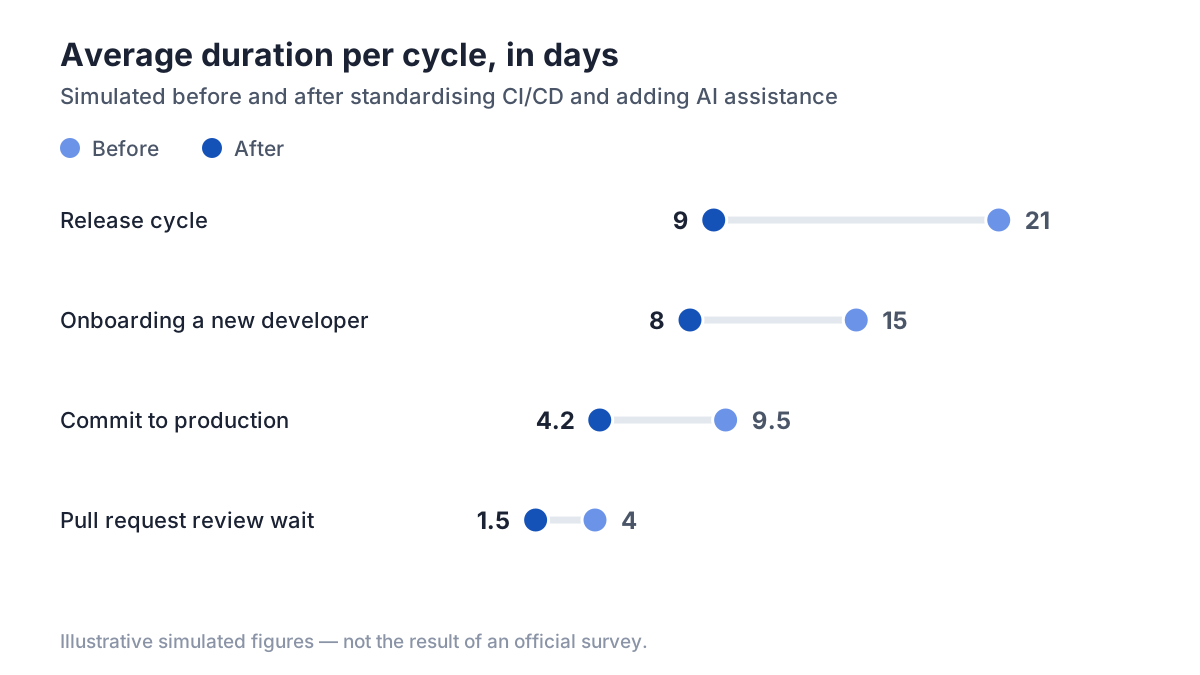
A shorter cycle does not only mean features ship sooner. It also means mistakes are cheaper: when a change reaches production in four days instead of three weeks, trying a direction and reversing it stops being a big decision.
What has not changed
Through every wave of technology, the things that decide whether a software project succeeds are the same as ever:
- Understanding the business correctly. No tool rescues a system built on a wrong assumption about how users work.
- A properly modelled data layer. Mistakes in the data model are the most expensive and least repayable form of technical debt.
- Automated tests where they matter. Prioritise calculations, permissions and money flows over chasing a coverage number.
- Handover and documentation. Software outlives the tenure of the people who wrote it.
New technology shortens the time it takes to build a product. It does not shorten the time it takes to understand the problem — that part still has to be paid in full.
How WinWin Software applies this
We choose technology by the expected lifetime of the project, not by how new it is. For operational management systems that a client will run for years, the first criteria are maintainability and ease of handover: a clear structure, consistent conventions, reproducible deployment environments, and documentation that lives with the code.
AI is used inside WinWin's own process where it is safe and clearly useful — generating tests, reviewing code, drafting documentation — while architectural and business decisions stay with people. That is how we move quickly without trading away the quality our clients have to live with.