
Artificial intelligence is reshaping how businesses operate, from process automation to data-driven decision making.
Only a few years ago, AI in most companies was a pilot project living inside the technology department: fun to build, nice to demo to the board, then quietly shelved. Today the story is different. AI is no longer a "nice to have" — it is becoming an operational layer, much like email or accounting software fifteen years ago.
What changed is not that the technology suddenly got smarter. It is that the cost of using it fell far enough for the economics to make sense. When a task that takes an employee 20 minutes can be done in 3, the investment question is no longer "can the technology do this?" but "how quickly does it pay for itself?".
From pilot project to operating infrastructure
AI is spreading faster than most technology waves before it. Where cloud computing needed close to a decade to become the default choice, AI is covering the same ground in a handful of years.

All figures in this article are simulated and used to illustrate the trend — they are not the result of an official survey.
More telling than the numbers is that the starting question has moved. Companies used to ask "can AI do this?"; now they ask "which process should we do first, and which metric proves it worked?". That is the mark of a technology past its curiosity phase.
Where AI creates the clearest value
AI's value is not spread evenly. It concentrates in work that is repetitive, follows a clear pattern, and costs time to read, understand and summarise. That is also why back-office teams tend to see results faster than engineering teams.
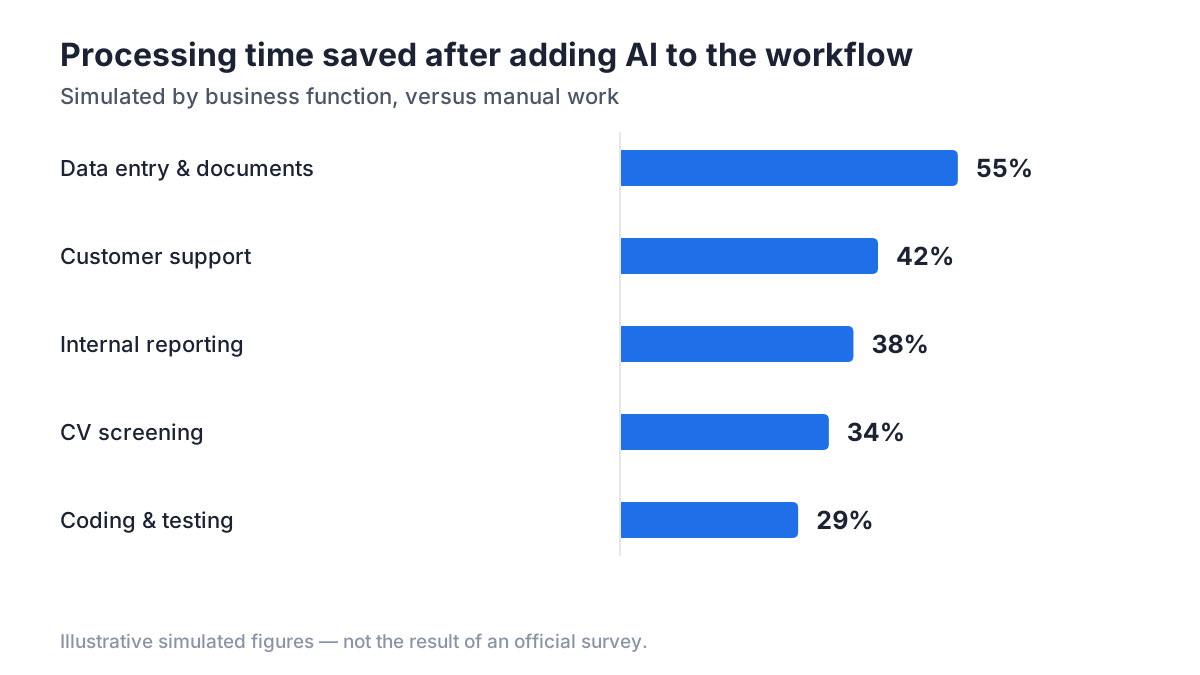
Three groups of use cases deliver the most consistent results:
1. An internal assistant over the company's own data
Instead of manually digging through thousands of documents, procedures and contracts, staff ask a question in plain language and get an answer with its sources cited. The key is to confine the knowledge scope to internal data so every answer can be verified.
2. Automated document and paperwork processing
Invoices, delivery notes, contracts, forms — AI reads them, extracts the fields and pushes them straight into the business system. People move from data entry to approval and exception handling.
3. Analysis and forecasting
Demand forecasting, unusual-stock alerts, receivables risk scoring, off-pattern transaction detection. Here AI does not replace the decision maker; it narrows the list worth reviewing from thousands down to dozens.
Three common obstacles
Most AI projects fall short for very ordinary reasons, not because the model was weak:
- The data is not ready. It is scattered across spreadsheets and systems with no common standard. AI amplifies data quality — the good and the bad alike.
- Nobody owns the business outcome. IT runs the project alone, with no owner in the department that actually uses it, so in the end no one can measure the benefit.
- Expectations are aimed at the wrong target. Hoping AI will replace a whole department in month one, instead of shortening one specific step and measuring one specific number.
AI cannot fix a process that is already wrong. It only makes that process run faster — including when it is running in the wrong direction.
How to start well
- Pick a process that hurts enough and is small enough. Favour daily, repetitive work that burns hours and produces measurable output.
- Define the metric before you build. Average handling time, error rate, backlog size — record today's number so you have something to compare against later.
- Clean the data within that scope only. You do not need to clean the entire data estate, just enough for the problem at hand.
- Pilot with a small team and keep a human in the approval step. AI output is reviewed by a person before it takes effect.
- Scale once the numbers prove it. Move to the next process only after real results.
How WinWin Software sees it
Across the systems we build — condominium management, warehousing, logistics, CRM — most of AI's value sits in unglamorous places: reading paperwork so a person does not have to, summarising a customer's interaction history, suggesting how to categorise a service request, flagging unusual figures before they become incidents.
Our approach is to embed AI into the existing workflow rather than build a separate AI system. People keep working on the screens they already know; AI runs behind them and only surfaces when it genuinely helps. That is how a technology project lasts — not through an impressive demo, but through the hours it saves every month.
If your company is weighing where to begin, start with the process that consumes the most of your team's time — not with the technology that sounds most exciting.