
Digital transformation is not just technology — it is changing how an organisation operates to grow long term.
There is a common misunderstanding: that digital transformation means buying software. A company signs the contract, rolls out for a few months, trains its staff — and then everything drifts back to spreadsheets. The software is still there; nobody uses it.
The cause is almost always the same: the system was introduced without changing how the organisation actually operates. Successful transformation does not start with technology. It starts with a question: which data are we losing every day, and who would decide differently if they had it?
The gap is created by time, not by a project
The benefits of transformation rarely show up in the first quarter. They accumulate: data gets cleaner, processes carry fewer exceptions, decisions rest on numbers instead of instinct. The gap between a company that does this deliberately and one that stands still therefore widens year after year.
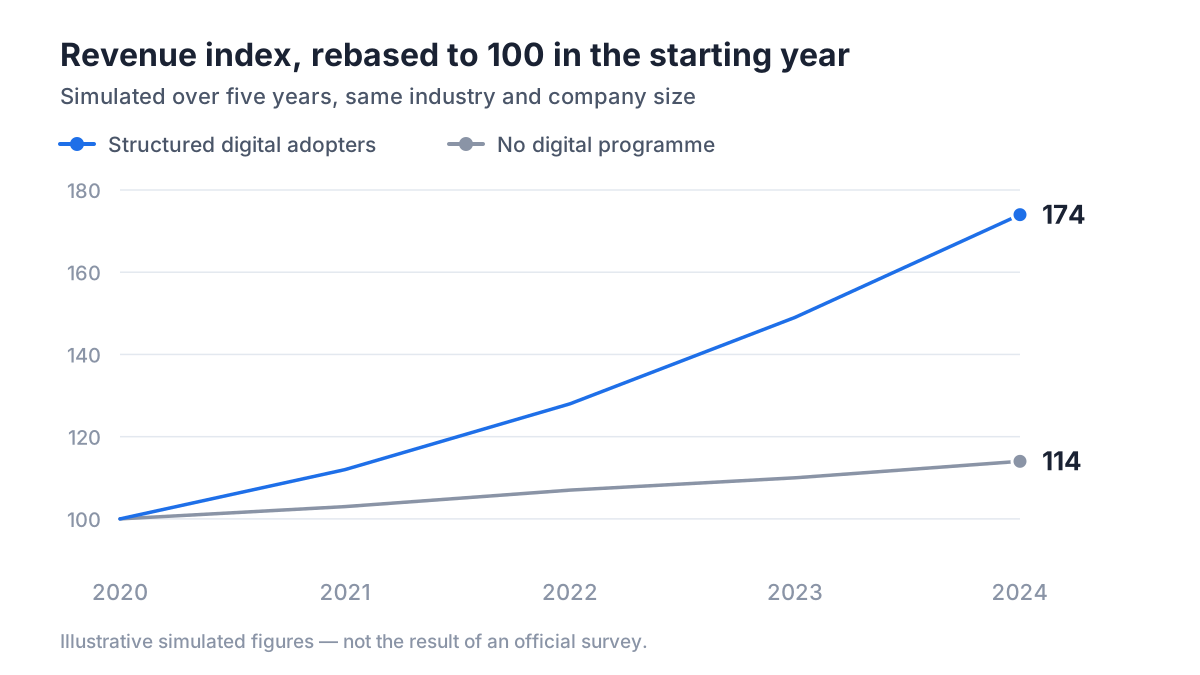
All figures in this article are simulated and used to illustrate the trend — they are not the result of an official survey.
The important part is the shape of the two lines: they sit almost on top of each other in year one. That is exactly the stretch where many companies give up — the cost has been paid, the result is not visible yet. Those who get through it are the ones who reach the real payoff.
The five stages of a digital journey
Transformation is not an on/off switch. It is a sequence of stages, and you cannot skip ahead: you cannot decide with data while the core processes are still on paper.

- Stage 1 — Digitising documents. Paper becomes files. Fast and visible, but the data still is not usable by a machine.
- Stage 2 — Digitising core processes. Sales, inventory, accounting and HR run on a system. The data starts to have structure.
- Stage 3 — Connecting departments. A number is entered once and shared everywhere. This is where most companies get stuck, because it touches the boundaries of departmental ownership.
- Stage 4 — Deciding with data. Reporting stops being a month-end exercise and becomes a screen people look at daily.
- Stage 5 — Reinventing the business model. The data and the platform make new services possible that simply were not viable before.
Why "sustainable"
Growth built on transformation lasts longer than growth built on scale alone, because it rests on three things that compound over time and are hard to copy:
- Accumulated data. Every month of operation adds another layer of history — something a new competitor cannot buy.
- Standardised processes. When the process lives in the system rather than in a few people's heads, the company can grow without a matching growth in chaos.
- In-house capability. A team used to working with data will find the next improvement itself, without waiting for outside consultants.
The clearest sign of a successful transformation project is not that the system runs. It is that nobody wants to go back to the old way.
Four mistakes that derail projects
- Doing too much at once. Rolling out five modules across the whole company simultaneously. The operations team is overloaded, input data quality drops, and the system earns a bad reputation in its first month.
- Treating it as an IT project. The person who defines the scope should be accountable for the business result, not the person writing the software.
- Digitising a messy process as-is. Before putting a process into a system, ask which steps can be removed entirely.
- Measuring nothing. With no baseline before rollout, every later assessment is opinion — and next year's budget becomes very hard to defend.
A workable twelve-month roadmap
- Months 1–2: agree on three business metrics to improve and record today's values.
- Months 3–5: digitise the one core process with the clearest impact — usually sales or operations.
- Months 6–8: connect that process to accounting, so a number is only ever entered once.
- Months 9–10: build daily operating reports on real data, replacing manual reporting.
- Months 11–12: re-measure the three original metrics, capture the lessons, and choose the next process.
How WinWin Software works alongside you
We build management software for domains with dense operational rules: condominiums, warehousing, distribution and services. What the long-lasting projects have in common is that they started small, solved one real bottleneck, and expanded on the data they had already earned.
That is why our approach is business analysis first, code second: sitting with the operations team, walking through what they actually do, pointing out where time and data are being lost — and only then designing the system. Good software is software that, six months in, users cannot imagine a working day without.